

It is difficult to know where to begin my story, but it falls into three chapters: before, during, and after Sean’s presence in my life. It is a journey from heartbreak to hope, filled with several emotions in between.
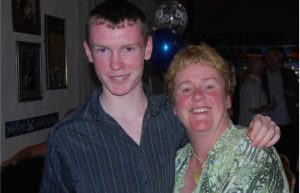
Phyllis and her son, Sean
Sean’s Early Life
Sean was born in Manchester 1996. A much longed for child and like most fortunate babies he was deeply loved. He was handsome (all mothers think that) and he had long delicate fingers that I was sure were destined for piano playing. Shortly after his birth we relocated back to Co Waterford where I had been born and reared. Sean was just six months old, life was good. It is not difficult to imagine the contrast from a huge city to the idyllic coast, mountains and woods that surround us here. We were indeed blessed and living the dream.
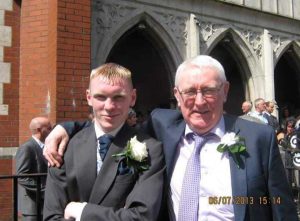
Sean with his dad, Tom.
Sean was an only child and as such we cared for him immensely. He did manage to find himself in unusual situations but there was really no harm in him. He loved having the craic and was always in the thick of any devilment. He could be quite stubborn and did not embrace authority well. Sean did not take to the usual GAA activities but excelled at Taekwondo. It was one of his passions; he sometimes got carried away with enthusiasm whilst practicing and we had the holes in the walls and doors to prove it. He won accolades over the years that made him and us immensely proud. He also acquired a love for fishing; he did not pick it off the ground but inherited that from his dad, Tom. However, patience was not his greatest virtue (he inherited that from me) but he persevered with the fishing and did catch a couple of trout – although he never actually ate the fish!
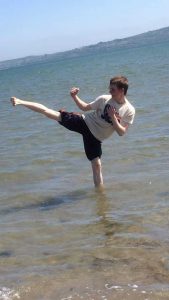
Sean practicing Taekwondo
Teenage Years and Struggles
Sean’s teenaged years were difficult. He was not given to talking about his feelings and presented outwardly as if nothing bothered him. School was challenging and he struggled with authority. We tried to support him, but he was unable to accept our support. He left mainstream education and was persuaded to go to Youth Reach which really helped him find his identity. It was less focussed on academia and a more integrated approach to education.
He was 17 years old, immature, and ill equipped for adult life. Again, he presented as not caring about anything, but we knew it was a front. He was shy, uncertain, and unable to articulate his feeling in any meaningful way. They were hard years for him and for us too. The old saying that wisdom does not come before age is true. I often wonder, would the now 30-year-old Sean, be kinder and more compassionate to himself.
The Day Everything Changed
The dream we were living turned into a nightmare on 8th September 2017 when Sean took his own life. He was 21 years old. There is no word that adequately names a parent who loses a child in any manner. It is undefinable, unimaginable, and totally against what we believe is the normal flow of life. To lose a child to suicide seriously and permanently disrupts that flow. My very senses recoiled on receiving the news of Seans death in disbelief. I felt like I was at the epicentre of an earthquake. My world had somehow collapsed and there was neither sense nor meaning to be found. My mind screamed denial as this could not be real. I kept expecting to wake, and it would all just have been a horrific nightmare. It felt like a dense fog had descended, and somehow life all around me continued but mine was frozen in time.
I know in those incredibly early, desperate days we functioned automatically. Family, friends, neighbours and colleagues gathered around us. Just as it takes a village to rear a child, it also takes a village to mourn. There was a huge outpouring of shock, grief, support, and even a little gossip too. People appeared with offers of practical and emotional support to help Tom and I as we tried to adjust to the enormous burden of loss. The repetition of telling and retelling the story felt important – as if by saying it aloud again and again it would become real. Those who could stay with us in discomfort — their own and ours — sharing and witnessing the loss of our beautiful son Sean, became our tribe. They allowed us to be exactly as we were messy, sleepless, confused, heartbroken, and lost.
Surviving the Aftermath
Following Sean’s funeral, when things quietened down, I remember thinking — now what? The world went gently and unapologetically on, but my world was still submerged in the aftershock of the earthquake. I did not want to go back to normal. I had no clue what this new normal was.
My mind wanted to shut down. I did not want to engage with anyone or anything. I avoided as many people as I could. I did not know how to be with myself, my grief, or my despair.
In those incredibly early days of grief and confusion, I contemplated taking my own life to end the physical, emotional, and traumatic pain. There was so much emotional turbulence — guilt, shame, confusion, regret, blame, anger, and deep heartache. These feelings can be a normal response to traumatic loss, but I did not know that at the time. I felt like I was quietly going mad.
Thankfully I sought help. My GP is a kind, compassionate individual who supported me in accessing traumatic grief counselling. I was fortunate to meet a very skilful lady who allowed me to process my grief, to say the things I needed to say and to help me heal some of the pain. I was and am fortunate to have a small but significant support network of people for both the practical and the emotional stuff. It certainly is not one size fits all but the people who allowed me to be myself helped me a great deal. They got me get out for a walk. They listened even when I repeated the same story. They were patient, gentle and kind. The local beach became a sanctuary. I could cry, scream, and rail against the unfairness of life. This also helped.
Searching for Answers
By now I craved an understanding of suicide. I wanted answers, particularly to that big question WHY. I read everything I could find searching for the answer. That missing piece of the puzzle which would allow me to make sense of it all. I wanted to understand this complex issue. At the time I got caught up and overwhelmed by trying to find the answer to WHY. It was difficult to look at something without judgement when it deeply affected my core being and identity. I searched for WHY and I have since learned that WHY is a huge word with many distinct aspects. It has taken me years to let go of my WHY and I would like to share what really supported me on this part of my journey. A journey which involved rebuilding hope.
Finding Connection
I received enormous support from my family, significant friends, and appropriate professionals. I am and will always be grateful for their comforting, gifted presence in my life. Obviously, the passage of time and my own search for meaning have been of value and although I cannot put a timeline on it, I believe it is true that our grief does not shrink over time, but we can learn to grow around it.
A valued friend sent me a link to a book launched by the HSE and the National Office of Suicide Prevention. It was called “You Are Not Alone” HUGG collaborated on its development but at the time I was not aware of HUGG. At the launch, a lady spoke of the loss of her son and it resonated with me deeply. That brought me to the next chapter of my grief journey.
I took the leap of faith in phoning HUGG and left my number. Gosh, I was so nervous because I really thought no one could understand the complexity and dept of my grief. I was so wrong. A wonderful lady soon phoned me back. She too was bereaved by suicide and she actively listened while I stumbled and cried my way through my experience. I thought to myself – another gentle, compassionate soul, who just like me, understood suicide loss and “got it” . I joined a HUGG support group, and I knew within twenty minutes of being with that group that I had indeed found another tribe.
The volunteers facilitating the group were powerful, articulate, kind, funny, real women who just like me had lived experience of loss by suicide. They taught me to be kind to myself, and I taught them to meditate. I think I got the better half of the deal.
One particular lady in the group resonated deeply with me. She shared her loss and it was almost identical to mine. Grief was new to her, and I identified how far I had travelled in my own personal journey (almost three years at that point) It was a pivotal moment for me as I had not noticed the progress until then. I am so incredibly grateful for that lovely group’s encouragement. They offered me connection, support, and most of all, hope. I felt heard, seen and inspired by this unique collection of bereaved people just searching for a little understanding.
When I realised how far I had come on my own journey I knew I could offer this to my community in Waterford.
Giving Back: Creating Hope for Others
Four years after Sean’s death, I felt I was ready to share my lived experience and hope with others. I completed the volunteer training with HUGG and helped launch a suicide bereavement support group in Waterford in November 2021.
Ordinary, heartbroken people from all walks of life and circumstances have very courageously come through our doors at HUGG Waterford. It does not matter when they were bereaved and there certainly is no pecking order to griefs’ hierarchy. No one’s grief is greater or lesser than anyone else’s. We are all the same — supporting, sharing, and, I believe, easing each other’s grief. Most importantly, we offer visible hope to one another.
So, the hope continues, spreads, and grows– one bereaved soul to another. Just walking alongside, each other on this difficult, unimaginable path that we did not choose, but was chosen for us.
I am now stepping away from my volunteering with HUGG, but I want to wish everyone in the HUGG community ease and comfort in your own personal journey of grief. I would also like to express my tremendous gratitude to the wonderful people I have encountered along the way — my brilliant co-facilitators Tasha and Bridget, and our amazing champion Niall, all the way from Tipperary.
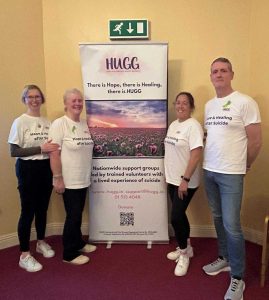
HUGG Waterford – Bridgit, Phyllis, Tasha and Niall
Thanks also to Marie, Arlene, Sheila, and the rest of the staff who are much more than staff and who bring their own unique lived experience of bereavement to this work.
Finally, my last words of appreciation are for Fiona Tuomey without whom there would be no HUGG. Your suffering, courage, vision, and determination have brought connection and support to so many across this great country of ours. I hope Milly’s legacy continues to grow in strength for those who may, unfortunately, need it in the future.
From heartbreak to hope – it is possible.
Phyllis.